
What Death means
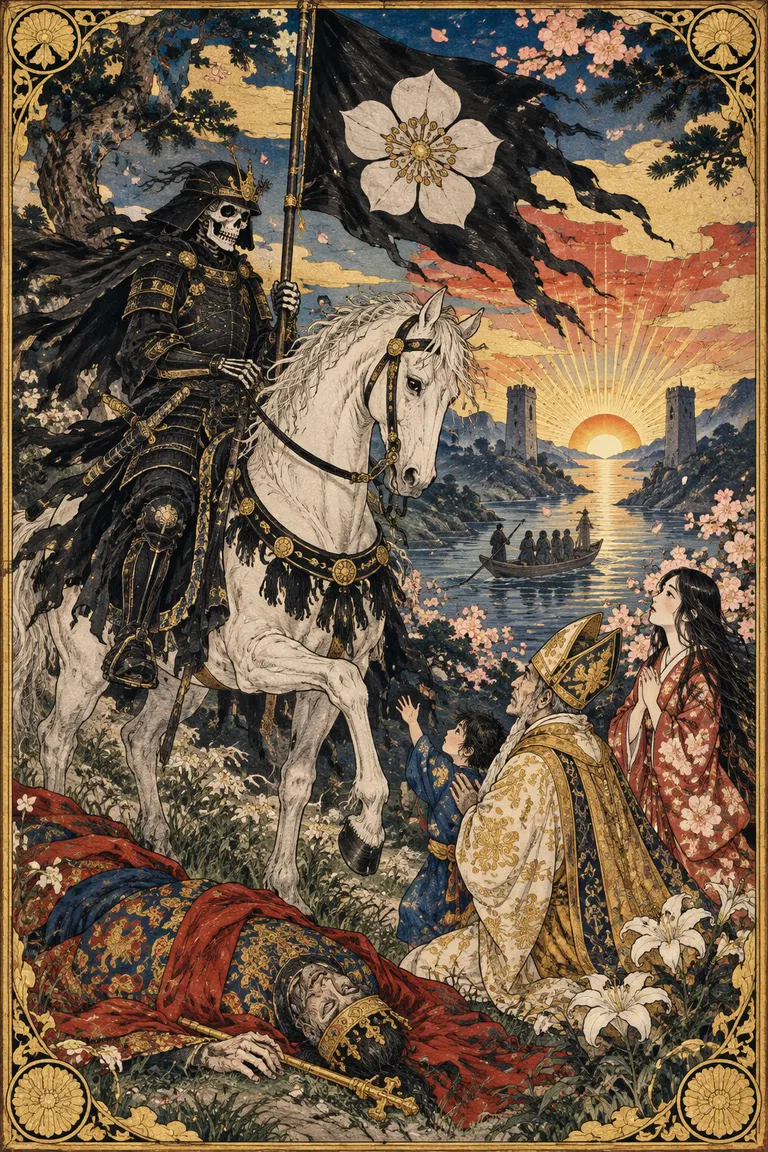
The thirteenth Major Arcana card causes more alarm than any other, and almost all of that alarm is misplaced. In the Rider-Waite image, a skeleton in black armour rides a white horse carrying a banner with a white rose. A king lies fallen, a bishop pleads, a woman turns away, and a small child offers flowers. On the horizon, between two towers, the sun is rising. The sun is the detail most people miss: this is a card about dawn as much as ending.
Death describes irreversible change. A chapter closes, a role is outgrown, an identity no longer fits. The skeleton does not negotiate, which is why the card feels harsh, but it also treats everyone equally, which is why it is honest. The white rose on the banner is a symbol of purity and renewal; what comes after the ending is cleaner than what came before.
In a practical reading, Death appears when a job, relationship, habit, home, or belief is finishing. The question is never whether to prevent the ending but how to go through it well. Draw a card now to see whether Death appears for your question. This interpretation is for reflection and entertainment only; it cannot predict health events and is not medical, legal, or financial advice.
Upright
Upright Death says a transformation is already in motion. Resisting it is wasted effort; the sensible move is to release what is leaving and make room. This can feel like grief even when the change is wanted, because endings carry loss regardless of what replaces them. The card does not minimise that, but it does promise that the ending is complete rather than partial.
Common upright scenarios include leaving a long-held job, closing a chapter with a person, moving away from a hometown, or dropping a self-image that has quietly become a cage. The card also favours cutting ties that have been frayed for a long time, since dragging them out costs more than finishing them.
Reversed
Reversed, Death describes a change that is stalled. You know something is over but keep it on life support out of fear, habit, or sunk cost. This often looks like staying in a relationship that has ended emotionally, keeping a business running past its viable point, or refusing to grieve so that you never have to move on. Stagnation and decay are the keywords here, and both are more draining than the clean break the upright card offers.
The reversed card can also mark a narrow escape: a change you feared did not happen, and you now have a second chance to make the transition deliberately rather than being forced.
Love
In love, Death rarely means a dramatic breakup out of nowhere. More often it marks the end of a stage within a relationship: the end of the honeymoon period, the shift from dating to living together, or the point where a couple must drop old roles to stay together. If a relationship has been failing for a long time, the upright card confirms that it is finishing, and suggests that ending it cleanly is kinder than letting it wither.
For singles, Death asks what pattern needs to end before a new connection can begin. Reversed, it describes clinging to an ex, re-reading old messages, or dating the same type of person while hoping for a different result.
Career
Professionally, Death points to redundancy, resignation, career change, or the end of a project or company. Upright, it is usually a release rather than a punishment, and people often look back on the Death-card period as the moment their working life changed direction for the better. Industries in decline, roles being automated, and skills that are no longer needed all fall under this card.
Reversed, you may be staying in a dying role because leaving feels harder than enduring. The card asks you to plan an exit rather than waiting to be pushed.
Money
With money, Death describes a financial chapter closing. That can be the end of a source of income, the final payment on a long debt, the sale of a major asset, or a change in how you relate to money altogether. Upright, the ending clears space; reversed, you may be throwing good money after bad or refusing to accept a loss. Review your situation honestly and consult a qualified adviser for real decisions; this is a tarot reading, not financial guidance.
Yes or No
Death leans no for questions about keeping the status quo, and yes for questions about whether something will end or change. Ask “Will this relationship survive as it is?” and the card says no. Ask “Should I close this chapter?” and the card says yes. The constant is transformation; the answer depends on which side of it you are standing on.
What not to ask Death
Do not ask the Death card about anyone’s health, lifespan, or physical safety. The card has nothing to say on those subjects, and using tarot to guess at medical outcomes causes needless fear. Also avoid asking “How do I stop this change?” because the card’s answer will always be that you cannot. More useful questions are “What is ending?”, “What do I need to let go of?”, and “What is the dawn behind the towers?”