
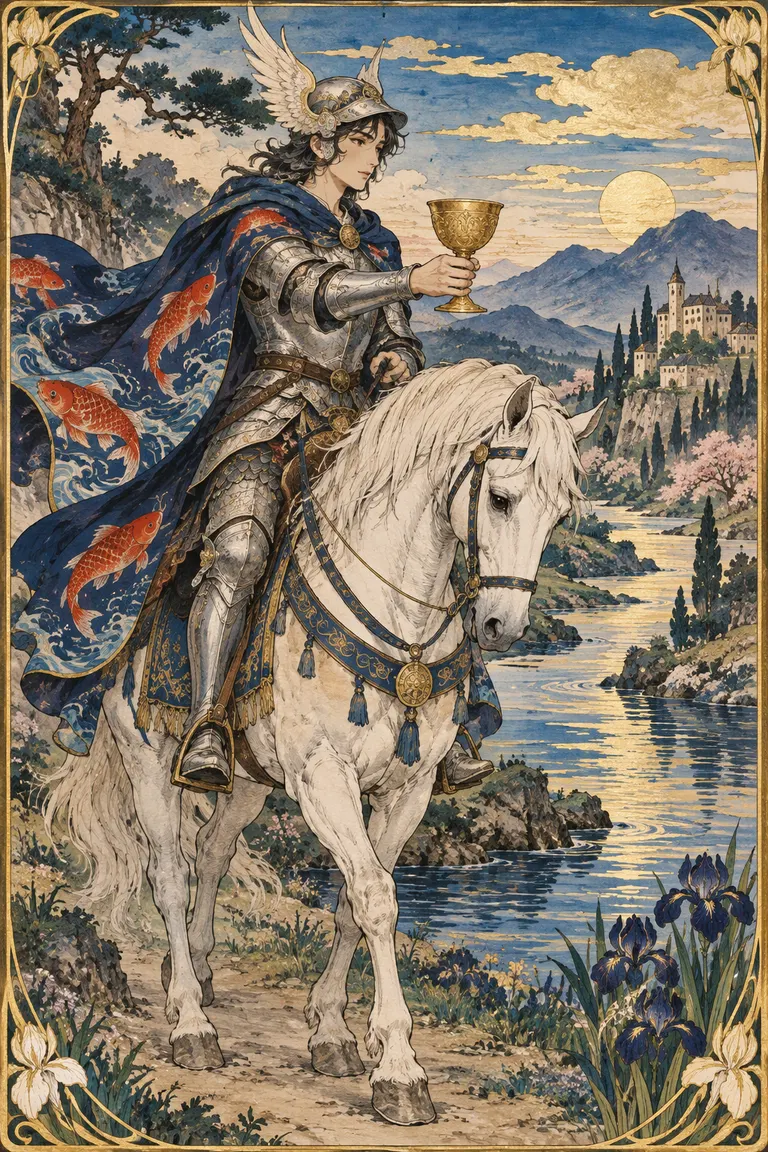
What Knight of Cups means
A knight in winged helmet and armour decorated with fish rides a white horse at a walking pace, holding a cup ahead of him as if presenting it. A river runs through the background. The Knight of Cups is the messenger of the suit of feeling: he is bringing something, and the way he carries himself tells you that the something is romantic, artistic or idealistic.
Unlike the other knights, he is not charging. His horse steps carefully. This is the deck’s romantic: the person who writes the letter, makes the gesture, arrives with the proposal. In a reading he can be an actual person entering your life, an invitation that arrives, or a mood you are in, where feeling leads and practicalities trail behind.
Draw a card now to see whether the Knight of Cups appears for your question. Tarot is a tool for reflection and entertainment and should not stand in for professional advice.
Upright
Upright, the Knight of Cups brings news that touches the heart. A message from someone you have been thinking about. An invitation to collaborate on something creative. A proposal, in the broad sense, that asks you to say yes to feeling.
He also represents an approach. Lead with charm, with sincerity, with emotional intelligence. If you are negotiating or asking for something, the Knight suggests the warm route works better than the forceful one right now.
There is a caution built into his image. The wings on his helmet and feet belong to Hermes, and messengers move on. The Knight of Cups is wonderful at arriving and less reliable at staying. Enjoy the offer; verify the follow-through.
Reversed
Reversed, the cup tips and the charm curdles. Common forms:
- Someone whose romantic words are not backed by action.
- Moodiness, sulking, or emotional pressure used to get a result.
- Falling for an image of a person rather than the person.
- Your own tendency to drift into daydreams instead of making a decision.
The reversed Knight of Cups can also describe disappointment when an idealised situation meets reality. The creative project is harder than it looked. The person is less attentive once the chase ends. The card asks you to separate how something felt in the pitch from how it functions day to day, and to be honest if you have been doing the pitching.
Love
The Knight of Cups is the classic suitor card. For singles, he often represents someone who approaches you with warmth and obvious interest: a romantic message, a thoughtful date, a declaration. The attraction is real and the attention is pleasant.
The question is durability. This Knight is sincere in the moment, and the moment can be enough for a lovely stretch. If you want more than that, watch whether his gestures become habits.
For couples, the card suggests a tender phase: apologies, renewed courtship, or one partner making a real effort to reconnect emotionally. Reversed, it points to empty romance, jealousy, or someone who is in love with being in love rather than with you.
Career
Professionally, the Knight of Cups favours creative, caring and people-facing work: design, writing, music, counselling, hospitality, diplomacy. He can mark an offer in one of these fields, or a collaborator who brings emotional intelligence to a team that needed it.
He also describes a working style. Persuasion over pressure, inspiration over spreadsheets. That works in pitches and relationships but can falter in delivery, so the card is strongest when paired with practical support.
Reversed, it warns of a colleague or employer who charms and under-delivers, a job sold on culture that turns out to be mostly talk, or your own habit of starting creative work and abandoning it when the glow fades.
Money
The Knight of Cups is not a money card in any direct sense. Financially he describes spending driven by feeling: generous gifts, romantic trips, art, beautiful things. None of these are wrong, but the card asks whether the budget agrees.
He can also indicate an offer with emotional pull, such as investing in a friend’s creative venture or lending to someone you care about. The Knight says the feeling is genuine. He does not say the numbers work.
Reversed, he warns of being sweet-talked into a financial decision, or of using purchases to manage moods. For any meaningful financial choice, a qualified adviser beats a charming one.
Yes or No
The Knight of Cups leans yes, softly. He is an offer, an approach and a kind message, which supports questions about whether something romantic or creative will arrive, and whether someone’s interest is genuine in the present.
The lean stops short of a firm yes because this Knight is a messenger, not a guarantor. He delivers the invitation; he does not promise the outcome. For questions about long-term reliability, treat him as a maybe and look for a Pentacles card nearby. Reversed, the answer is closer to no, or at least “not as presented.”
What not to ask Knight of Cups
Do not ask the Knight of Cups whether someone will commit to you. He describes the approach and the feeling; commitment belongs to other cards and, more usefully, to the other person’s behaviour over time.
Avoid asking him to validate a fantasy you already know is unrealistic, or to make a financial or legal call, where his charm has no bearing. The Knight of Cups answers best when the question is: “What is being offered to me emotionally, and is it being offered honestly?”