
What The Hierophant means
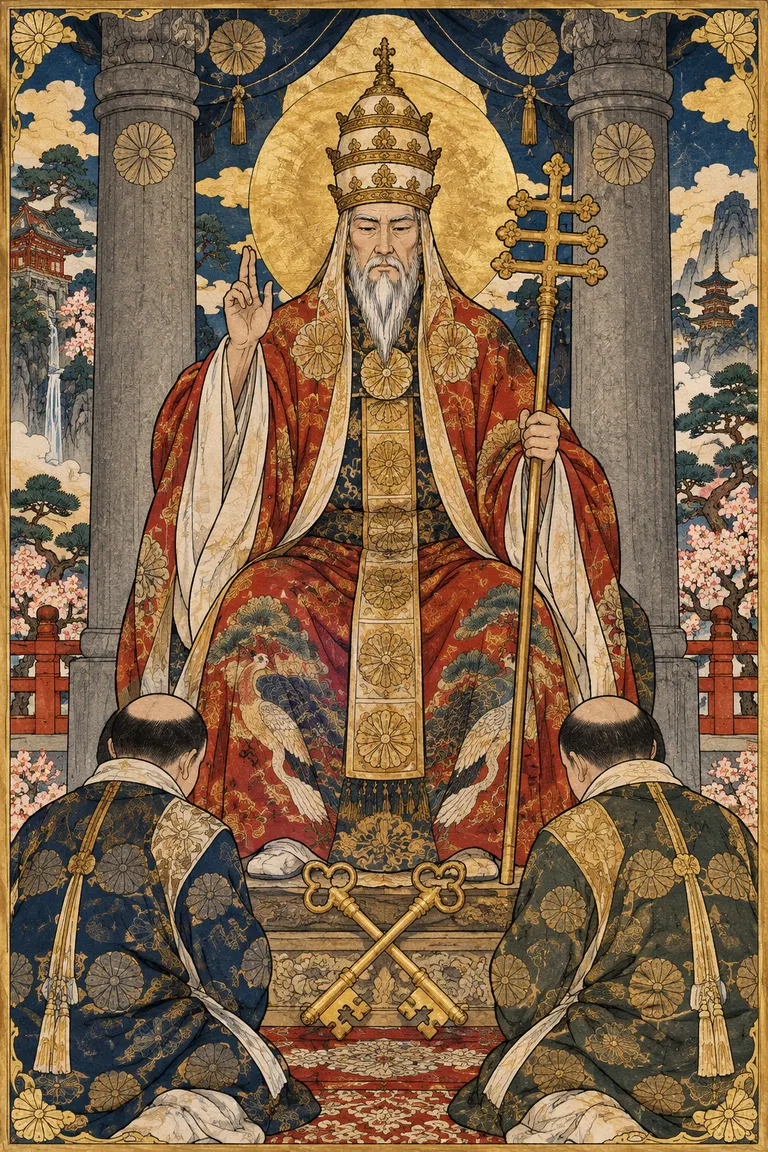
The Hierophant is card five. In the Rider-Waite deck he sits on a throne between two grey pillars, wearing a triple crown and holding a staff topped with a triple cross. His right hand is raised in blessing, two fingers up and two down. Two tonsured monks kneel before him, and two crossed keys lie at his feet. The scene is formal, symmetrical, and built to last.
He represents tradition, teaching, and the institutions that pass knowledge from one generation to the next. Draw a card now to see whether The Hierophant appears for your question. This page is for reflection and entertainment and is not a substitute for medical, legal, or financial advice.
Upright
Upright, The Hierophant says the conventional path is the right one for now. There is a reason things are done the way they are done, and the card asks you to learn that reason before deciding to break from it. The crossed keys represent access to knowledge that is granted through study and initiation rather than improvisation. The two monks are students; the card often appears when you need a teacher, a mentor, or a structured course.
He is also a card of belonging. Joining a community, a profession, a faith, or a family carries obligations and rewards, and The Hierophant upright is weighted toward the rewards. If you have been going it alone and finding it hard, the fix may be to find the people who have already walked the path.
Reversed
Reversed, the institution stops serving and starts constraining. This can be a dogma you have outgrown, a set of expectations you have been meeting out of habit, or a teacher who is more interested in being obeyed than in your learning. The reversed Hierophant appears when you are ready to question something you were raised to accept, and the questioning is healthy.
The other side is rebellion without substance. Rejecting tradition because it is tradition is as unexamined as following it for the same reason. Reversed Hierophant asks which you are doing: thinking for yourself, or just pushing against whatever is in front of you. There is also a quieter reading: feeling like an outsider in a group you were supposed to belong to.
Love
The Hierophant in love is about formalizing. Upright, it points toward engagement, marriage, a public commitment, or a relationship built on shared values and the approval of family and community. For singles it suggests meeting someone through established channels, such as friends, faith communities, or work, rather than chance.
The shadow is a relationship that follows a script. Reversed, the card describes a couple going through the motions because that is what couples do, or one partner rebelling against expectations the other still holds. It can also point to a difference in values that has been papered over. If the question is about whether to make something official, reversed Hierophant suggests the ceremony would be ahead of the substance.
Career
The Hierophant favors professions with clear training paths and credentials: medicine, law, teaching, academia, religious work, trades with apprenticeships, large institutions with defined ladders. Upright, it supports getting the qualification, joining the professional body, or finding a mentor inside the organization. It is a strong card for teachers and for anyone whose job is to pass on what they know.
It is a weak card for disruptors. If you are asking whether to leave a stable institution to do something unconventional, The Hierophant upright is cautioning you, and reversed it is saying the institution has become the problem.
Money
The Hierophant is conservative about money in the plain sense of the word. Upright, it favors established methods: a pension, a long-standing bank, a budgeting method your family used, advice from someone with proper credentials. It supports spending on education and on obligations to community, such as giving or family support, as long as those obligations are chosen rather than extracted.
Reversed, the card can describe a financial institution that is not acting in your interest, or inherited money habits that no longer fit your situation. None of this is financial advice. The card is a prompt to ask whose rules your money is following.
Yes or No
The Hierophant leans yes, with a clear condition: the answer is yes if the question involves doing things the established way. Formal commitments, qualifications, seeking guidance, joining something, and following procedure all get a yes. Unconventional plans, shortcuts, and breaking from a group get a no from this card upright. Reversed, the lean flips: it becomes a cautious yes for questioning and leaving, and a no for doubling down on a system you have stopped believing in. The card rarely says maybe; it is a card of clear positions.
What not to ask The Hierophant
Do not ask The Hierophant for permission to be original. He is the wrong card for creative or unconventional questions and will tend to push you back toward the known path even when the known path is not the right one for you.
Do not ask him to settle a question of personal belief. The Hierophant represents the institution, not the conscience. If you are asking whether to stay in a faith, a family tradition, or a professional culture, the card can tell you what the institution expects, but it cannot tell you what you believe. Ask instead what you have learned from the system you are in, and whether you are still learning or only complying.