
What Three of Swords means
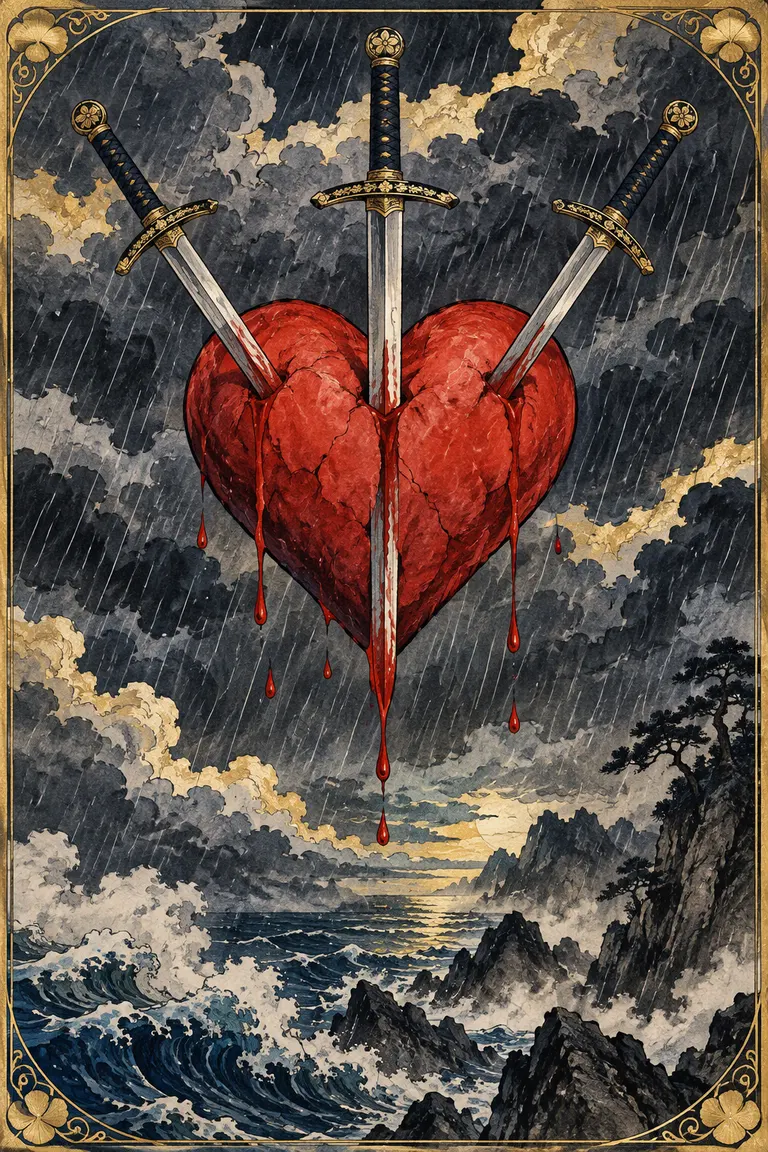
Three swords pierce a red heart against a grey sky and falling rain. There are no people in the Rider-Waite image, which is part of its force: the Three of Swords is pain without a story yet, the moment of impact before anyone has explained it.
It is one of the few cards whose meaning most people guess correctly on sight. Heartbreak, loss, betrayal, bad news. But the suit of Swords is the suit of thought and truth, and the card’s deeper meaning is clarity that hurts. The swords are precise. They cut through fog. What they reveal may be unwelcome, but it is usually accurate.
Draw a card now to see whether the Three of Swords appears for your question. These readings are for reflection and entertainment; if you are struggling, please speak to a doctor or counsellor rather than relying on a card.
Upright
Upright, the Three of Swords describes a wound that is real and present. Someone has said something you cannot unhear. A relationship has ended or shifted. A hope has been shut down. The card does not soften this.
What it does offer is honesty. The rain in the image is often read as release: the storm is also the thing that clears the air. In a reading, the upright Three suggests that the painful fact is better known than hidden, and that pretending otherwise would hurt longer.
Practically, the card advises letting yourself feel what has happened before trying to fix it. People often draw it when they are rushing to be fine. It also warns against adding a fourth sword by replaying the hurt in your head beyond what is useful.
Reversed
Reversed, the Three of Swords splits into two readings, and the surrounding cards decide which applies.
The hopeful version is recovery. The swords are being drawn out, the rain is stopping, and you are beginning to talk about the loss in the past tense. Forgiveness, closure or simply time has done its work.
The harder version is avoidance. You have decided not to feel the thing. The relationship ended and you have booked every evening solid. The criticism landed and you have explained it away. The swords are still in; you have just stopped looking at them. The reversed card in this mode asks you to stop managing the pain and let it be felt so that it can finish.
Love
In love, the Three of Swords is the card people fear, and it does frequently describe separation, infidelity or a conversation that ends things. For couples, it can also surface a long-standing hurt that has never been addressed, which is painful but not necessarily fatal. Some relationships survive the Three of Swords by finally telling the truth.
For singles, it often refers to the past rather than the future: an old heartbreak still shaping how you approach people, or a fear of being hurt that keeps you from connecting.
Reversed, it suggests either healing after a breakup or refusing to acknowledge that one has already happened emotionally. Be honest with yourself about which.
Career
At work, the Three of Swords shows up around rejection and harsh feedback. A job you did not get, a project cancelled, a performance review that stung, or a colleague who undermined you. It can also describe the emotional side of redundancy, which people are often told to treat as purely practical.
The card’s advice is to separate the fact from the wound. The feedback may be accurate even though the delivery hurt. The rejection may be about fit rather than worth. Take what is useful from the truth and let the rest drain away.
Reversed, it can mark recovery from a professional setback, or an unresolved grievance you keep carrying from job to job.
Money
Financially, the Three of Swords points to loss and the emotions attached to it. A bad investment, money lost to someone you trusted, a divorce settlement, or an unexpected bill that lands on top of other stress. The sting is as much about betrayal or regret as about the sum.
The card does not predict further losses. It asks you to look at the figure clearly and feel what you feel about it without letting shame stop you from taking practical steps. Those steps, for any significant loss, should involve a qualified adviser, not a tarot deck.
Reversed, it may indicate slow repair after a financial blow, or a refusal to open the envelope.
Yes or No
The Three of Swords is a no. It represents hurt, separation and disappointment, and for most questions about whether something will go well, that is its answer.
There is one honest exception. If you are asking whether to confront a painful truth, have a hard conversation, or end something that is already over, the card supports doing it, because clarity is its gift. In that narrow sense it is a yes to facing reality. Reversed, read it as a maybe that depends on whether you are healing or avoiding.
What not to ask Three of Swords
Do not ask the Three of Swords whether a specific person has betrayed you. The card describes pain and truth in general; it cannot identify a culprit, and treating it as evidence will damage relationships that may be innocent.
Avoid asking it about illness, grief or mental health as if it could diagnose or predict. Those belong with medical professionals and people who can sit with you in person. The Three of Swords is most useful when asked: “What truth am I avoiding, and what would it cost me to accept it?”